
Professional Fire Damage Restoration Protocols for Commercial Assets

A commercial fire does not just damage walls. It triggers a complex web of regulatory requirements and structural risks that can shutter a business permanently. For property managers in major urban markets like Toronto, understanding the technical requirements for fire damage restoration is essential because the first 48 hours determine whether you recover your assets or face a total loss. This guide outlines the technical benchmarks and regulatory hurdles you must clear to reopen safely.
The commercial standard for fire damage restoration: why ANSI/IICRC S700 and S500 matter
Defining the technical benchmarks
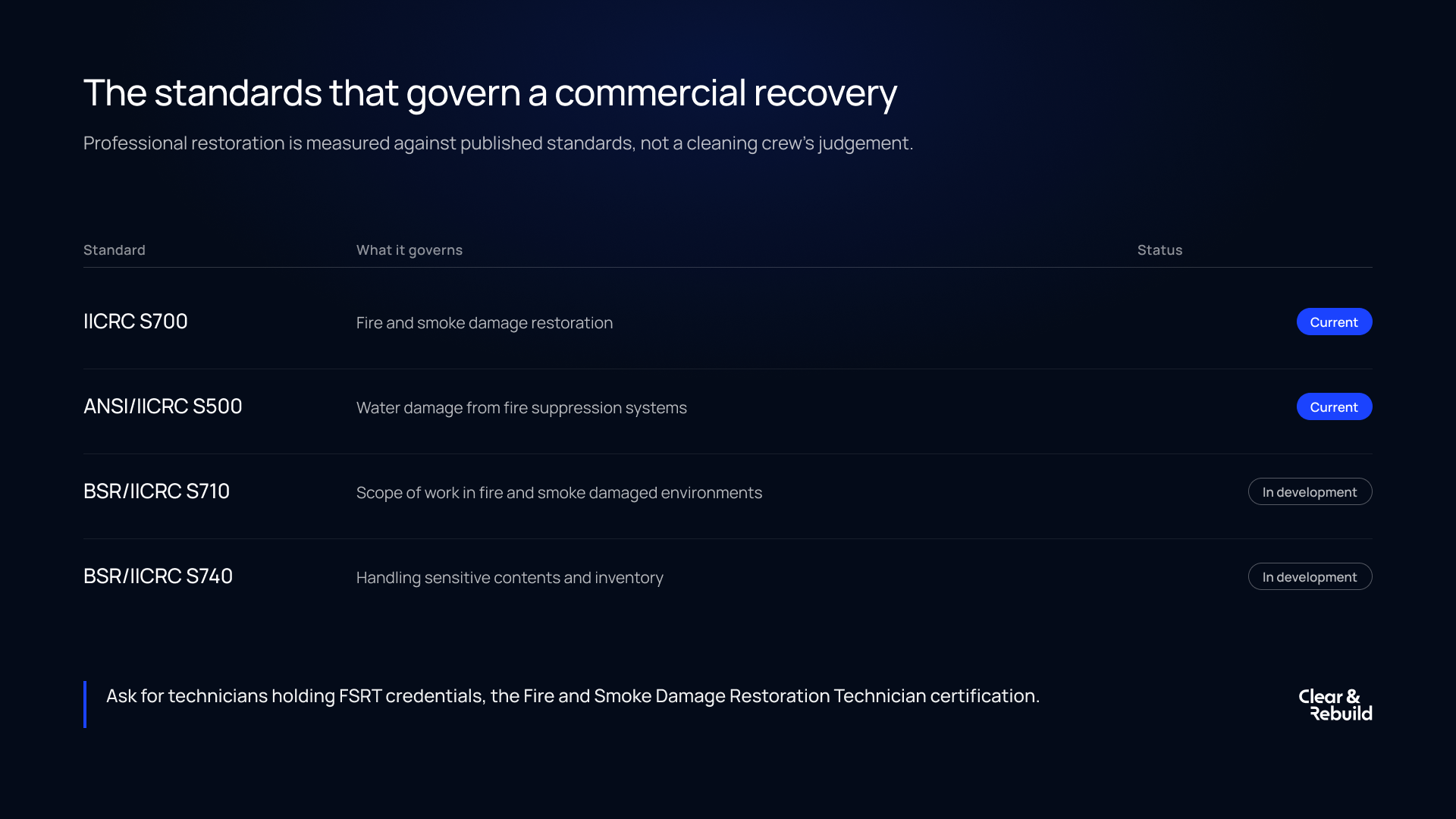
Professional restoration is governed by strict industry standards that separate expert recovery from basic janitorial work. The IICRC S700 standard serves as the primary framework for professional fire and smoke damage restoration. It provides the rules for cleaning structural components and managing air quality.
Some properties also suffer water damage from fire suppression systems. In these cases, the ANSI/IICRC S500 provides the necessary procedures for moisture control and structural stabilization. These standards ensure every step of your process is measurable and scientifically sound. If moisture is left unaddressed, building managers should consult mold remediation experts to prevent secondary biological growth from compromising the structure.
The role of the S710 scope of work
Determining the exact requirements for a full recovery requires a formal assessment. The industry currently relies on the S700, but a new standard for developing a professional scope of work in fire and smoke damaged environments, known as BSR/IICRC S710, is currently in development.
This new protocol will improve how restoration partners document damage. For now, insurance carriers rely on existing IICRC standards to justify claim amounts. It is critical to work with technicians who hold Fire and Smoke Damage Restoration Technician (FSRT) credentials. Clear and Rebuild ensures that property owners are matched with licensed, vetted contractors who understand these specific technical requirements.
The HVAC decontamination and commercial smoke remediation requirement
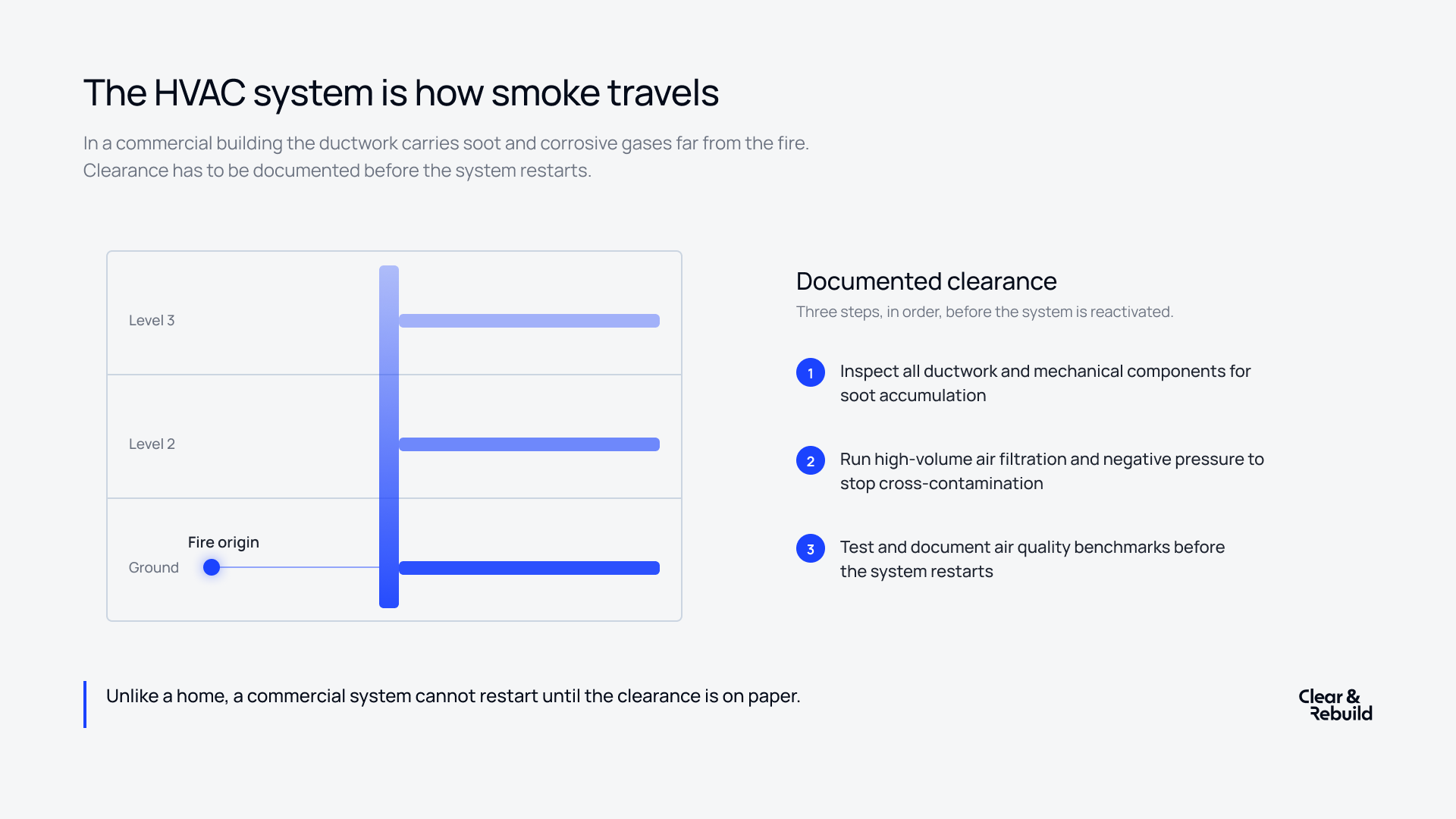
Smoke migration pathways are the channels through which combustion byproducts travel throughout a building. These include fine particulate matter and corrosive gases that often travel far from the original fire source. In large-scale commercial facilities, the HVAC system acts as the primary highway for these materials. Consequently, specialized commercial smoke remediation is necessary to neutralize odors and toxic residues trapped within the ventilation network.
Unlike residential settings, commercial systems require documented clearance. This ensures toxic residues are not recirculated once the building reopens. To ensure proper HVAC clearance, professionals follow these steps:
Navigating the regulatory multiplicity
Regulatory safety and site safety
Recovery operations must prioritize worker safety under federal and state mandates. Fire cleanup and debris removal are classified as hazardous waste operations.
Employers must designate a qualified site safety and health supervisor who implements a safety plan and ensures strict OSHA 1926.65 compliance throughout the cleanup process. This includes mandatory training and providing Personal Protective Equipment (PPE) for anyone entering the site. For projects involving significant debris, following a technical post-construction sequence ensures that structural cleaning occurs before final detailing.
Local building codes in Toronto
Property managers in cities like Toronto must navigate overlapping rules to secure re-occupancy permits. The documentation requirements are rigorous and often involve multiple agencies:
Mitigating secondary damage: soot and electronics
Soot is a chemically reactive substance, not just an aesthetic issue. Combustion byproducts often contain acidic elements that cause rapid corrosion of sensitive electronics and metal surfaces. If stabilization does not occur within the 48-hour window, the cost of asset loss increases quickly. If the building was also compromised by external elements, facility managers may need to coordinate a storm damage repair to seal the envelope before interior work continues.
FSRT-certified technicians understand combustion byproduct chemistry. They use specific cleaning methods to neutralize these contaminants before they drive deeper into building materials. Handling sensitive inventory requires specialized methods currently being formalized in the BSR/IICRC S740 standard.
Professional restoration involves evaluating whether to recover or replace items based on the type of soot present. You should use a professional scope of loss prepared by a qualified expert. This ensures insurance claims reflect the true technical cost of restoring high-value commercial equipment. Depending on the region, you should also verify wildfire coverage limitations that may impact recovery budgets.
Checklist for commercial re-occupancy
Re-occupancy verification steps
Professional oversight ensures these technical standards are met without the risks of unvetted remediation. Clear and Rebuild provides professional oversight from the first quote to the final walkthrough, ensuring property managers do not have to project-manage trades they cannot vet themselves. Your next step is to verify the credentials of your restoration partner to ensure they can produce the documentation your insurer and local building department will require.
Ready to restore your property? Contact us to connect with vetted restoration professionals today.
